
Inventory Management
Take Control of Your Inventory. Keep Your Business Moving.
Gain real-time visibility into stock levels, movements, availability and replenishment — with an Inventory Management solution that can run independently or grow into a connected business platform.
Continuum Inventory Management gives businesses a dedicated platform to control stock, products, locations, movements and replenishment without requiring a complete ERP system.
Use it independently, connect additional Continuum business modules as your requirements grow, or deploy it as part of the complete Continuum ERP platform.
Better Inventory Visibility. Better Business Decisions.
Inventory affects almost every part of your operation.
When inventory information is fragmented across spreadsheets, locations, systems, or departments, businesses can struggle with inaccurate stock levels, delayed replenishment, excess inventory, stock shortages, and limited visibility.
Continuum helps bring inventory information together into a connected solution where your teams can monitor stock, track movements, manage replenishment, and understand inventory availability from one place.
Whether deployed independently or connected with other Continuum solutions, inventory information remains centralized, traceable and accessible to the teams that need it.
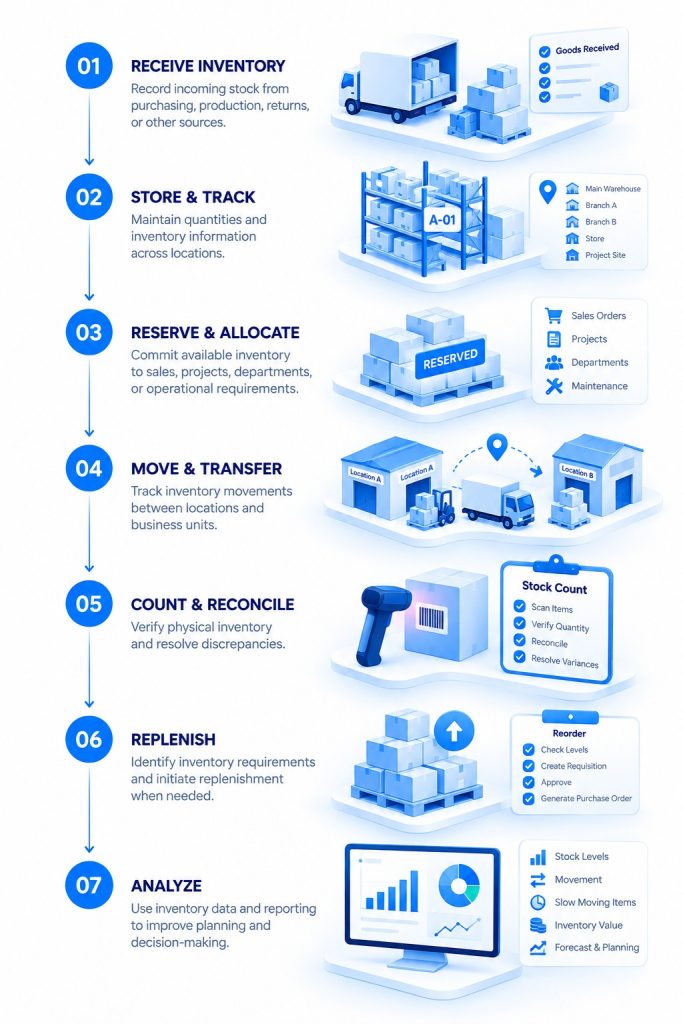
Inventory Management Capabilities
Gain real-time visibility and control over stock, movements, replenishment, costing, and inventory performance across your operations.
Real-Time Inventory Visibility
See what inventory is available, reserved, incoming, committed, or unavailable across your business.
Provide teams with a clearer view of inventory quantities and status without relying on disconnected spreadsheets or manual updates.
Multi-Location Inventory
Manage inventory across warehouses, branches, stores, stockrooms, project sites, or other business locations.
Track quantities by location and give authorized teams visibility into where inventory is currently held.
Product & Item Management
Maintain centralized product and item records including SKUs, categories, units of measure, pricing references, inventory attributes and tracking requirements.
Stock Movement & Transfers
Track inventory as it moves between locations, departments, warehouses, or business units.
Maintain a clear record of transfers and stock movements while improving accountability throughout the inventory lifecycle.
Inventory Replenishment
Identify when inventory needs to be replenished based on minimum stock levels, reorder points, demand, or defined business rules.
Create replenishment processes that help reduce stock shortages while avoiding unnecessary inventory accumulation.
Stock Adjustments
Manage inventory adjustments for damaged, lost, expired, returned, or corrected stock.
Apply approval workflows and maintain transaction history to provide better control over inventory changes.
Lot, Batch & Serial Tracking
Track inventory using lot numbers, batches, serial numbers, or other identifiers when required by your operation.
Improve traceability from receipt through movement, usage, sale, or distribution.
Inventory Reservation & Allocation
Reserve or allocate available inventory against sales orders, customer requirements, projects, departments, or operational demand.
Help teams understand what stock is physically available and what inventory has already been committed.
Inventory Counting & Reconciliation
Support periodic, cycle, or scheduled stock counts and compare physical quantities against system records.
Identify discrepancies and maintain more accurate inventory information through structured reconciliation processes.
Inventory Valuation & Cost Visibility
Connect inventory transactions with financial and costing processes to provide better visibility into inventory value and associated costs.
Support more consistent inventory reporting and financial reconciliation.
Inventory Alerts & Notifications
Automatically notify responsible teams when inventory reaches critical levels or when defined inventory conditions occur.
Alerts can support situations such as low stock, excess stock, pending replenishment, expiring inventory, or inventory discrepancies.
Inventory Dashboard & Reporting
Turn inventory transactions into actionable information.
Monitor stock levels, inventory movement, slow-moving items, shortages, inventory value, replenishment requirements, and other operational indicators through dashboards and reports.
Connected Business Operations
Start with inventory. Connect the business processes around it when you are ready.
Standalone Inventory Management
Deploy Inventory Management independently to manage products, stock, locations, movements, replenishment, valuation and reporting without implementing a complete ERP system.
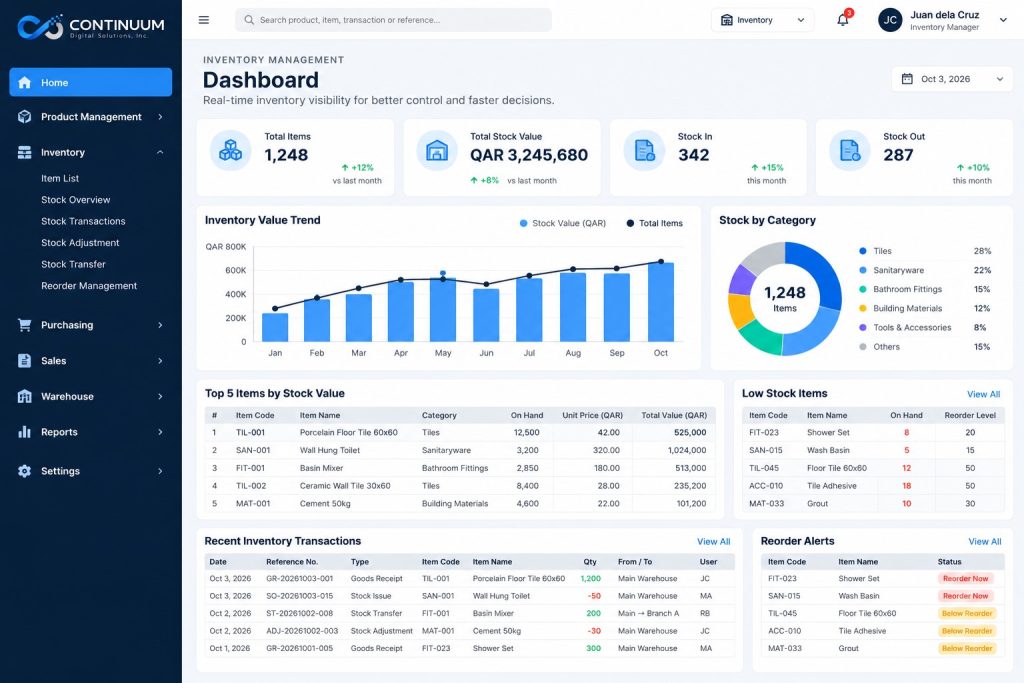
Run Inventory Management as an independent business solution with the tools needed to manage products, stock, movements, replenishment, valuation and reporting — without implementing a complete ERP system.
Request Free Consultation

Start with Inventory Management
Manage:
- Product & Item Management
- Stock Availability
- Multi-Location Inventory
- Receipts & Issues
- Stock Transfers
- Adjustments
- Replenishment
- Counting & Reconciliation
- Batch & Serial Tracking
- Inventory Valuation
- Reports & Dashboards
Start with Inventory. Connect More When You Need It.
Built Around Your Business
Your inventory requirements depend on your products, locations, transaction volumes, processes, and existing systems.
Continuum solutions can be implemented around the capabilities your business needs today and expanded as your operation grows.
Start with inventory visibility and stock tracking.
Start with inventory visibility and stock tracking.
Continuum Inventory Management can operate as a complete standalone inventory solution. As your requirements grow, additional Continuum modules can be connected without replacing your existing Inventory Management platform.
- Procurement & Supply Chain
- Warehouse Management
- Sales Management
- Accounting & Finance
- Production Process Management
Already Using an ERP or Business System?
You do not have to replace systems that already work for your business.
Continuum Inventory Management can connect with existing ERP, accounting, e-commerce, sales, procurement and operational platforms through our System Integration and AI solutions.
Need More Than Inventory Management?
Continuum ERP brings Inventory Management together with procurement, sales, warehousing, finance and other core business operations within one connected platform.
One system. Shared data. Connected operations.
Build a Smarter Inventory Operation
Whether you need a dedicated Inventory Management solution, additional connected business modules, integration with your existing systems or the complete Continuum ERP platform, Continuum can help you build the right solution around your operations.